
Cybersecurity is a balance-sheet problem. IBM's 2026 report puts the global breach average at $4.99 million, up 12%, and the US average at $11.5 million. Breaches took 247 days to identify and contain, up from 241.
Exposure is also moving. Verizon's 2026 DBIR shows software flaws as the leading entry point at 31% of breaches, while third parties appear in 48%.
For CISOs and risk leaders, cybersecurity risk belongs on the board agenda beside credit and liquidity risk. Boards must know exposure, accepted risk, and cost to close the gap. The board's job is to set risk appetite and fund the gap, not buy tools.
KEY TAKEAWAYS FOR THE BOARD
- Cyber risk is threat × vulnerability × impact: A control on any one factor lowers the whole.
- Quantify it: Annualized Loss Expectancy turns a security request into a payback test.
- Fund patch speed and vendor oversight: Software flaws start 31% of breaches and third parties appear in 48%, according to Verizon.
What Is Cybersecurity Risk?
Cybersecurity risk is the probability of financial loss, operational disruption, data compromise, or reputational damage from the failure or exploitation of digital assets, networks, or operational technology.
Practitioners express it as a product of three factors:
Cyber Risk = Threat × Vulnerability × Impact
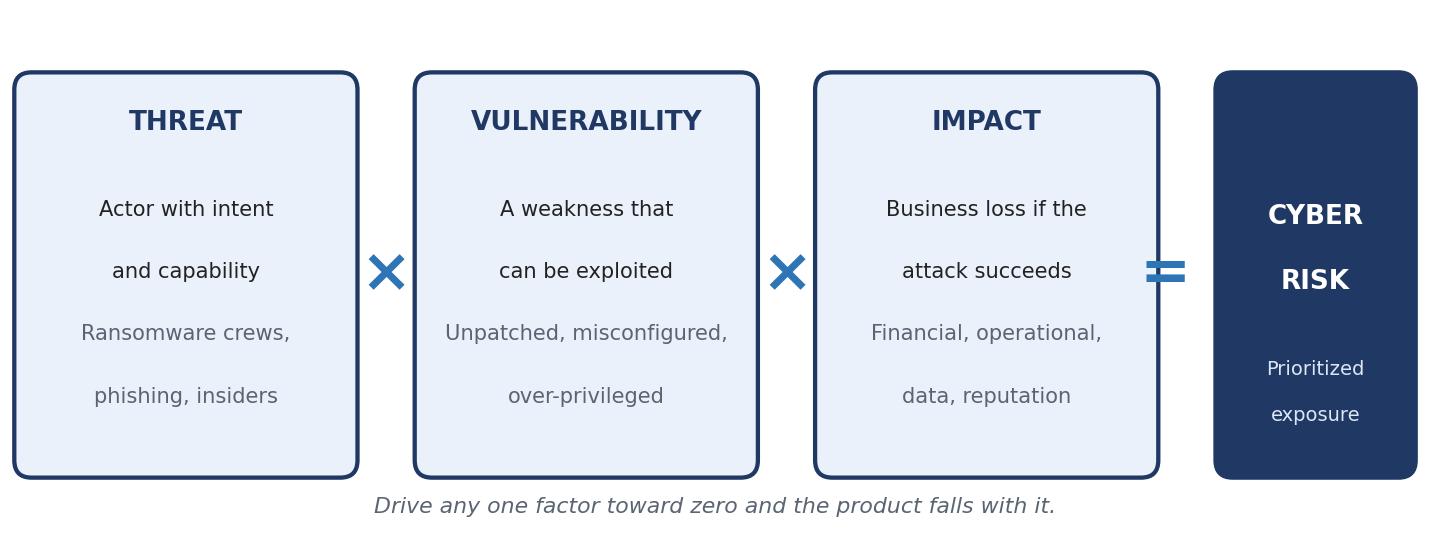
A threat actor supplies intent and capability, a vulnerability supplies the opening, and impact measures business loss. Because the factors multiply, patching, access control, and resilience planning all reduce the result.
NIST CSF 2.0 added Govern to Identify, Protect, Detect, Respond, and Recover, placing strategy, risk appetite, and accountability with senior leadership. For public companies, SEC cyber disclosure rules require Form 8-K disclosure of a material incident and annual reporting on board cyber-risk oversight.
Comparing inherent risk vs residual risk vs target risk shows whether controls are earning their cost:
| Risk state | What it measures | Question it answers |
|---|---|---|
| Inherent risk | Raw exposure before any controls | What could happen if nothing protected us? |
| Residual risk | Exposure remaining after controls | What is left after our safeguards? |
| Target risk | Exposure matching corporate risk appetite | What level can the business accept? |
The residual-to-target gap is the investment case.
The Economics of Cyber Exposure: Measuring Financial & Operational Impact
Cyber exposure is the financial and operational cost an incident creates through direct response, business loss, and regulatory liability.
Direct costs: forensics, ransom payments, legal defense, and crisis communications. IBM found AI-enabled breaches average about $6.29 million.
Indirect costs: customer churn, share-price pressure, supply chain delays, and brand damage. IBM attributes the 2026 rise mainly to detection, escalation, and lost-business costs.
Regulatory liabilities: the SEC requires Form 8-K disclosure within four business days of a materiality decision. GDPR fines can reach €20 million or 4% of worldwide turnover, whichever is higher, and HIPAA adds breach-notification duties and civil penalties.
How to calculate cyber risk in financial terms starts with the FAIR Framework, which separates loss event frequency from loss magnitude. A common shorthand is:
Annualized Loss Expectancy (ALE) = Single Loss Expectancy (SLE) × Annualized Rate of Occurrence (ARO)
Using IBM's US average of $11.5 million as SLE and an illustrative 10% ARO gives ALE of $1.15 million. A 4% likelihood lowers ALE to $460,000, avoiding $690,000. At an illustrative $300,000 annual cost, the return is 130%. Treat this as a prioritization tool.
Residual-to-Target Gap Scorecard
Apply the scorecard to each material scenario using the article's existing illustrative ALE example:
Model: Residual-to-target gap = residual expected annual loss - target expected annual loss.
| Scorecard field | Value | What it shows | Board action |
|---|---|---|---|
| Residual expected annual loss | $1.15M | Exposure after current controls | Measure |
| Target expected annual loss | $460K | Exposure within the illustrative appetite | Set / validate |
| Residual-to-target gap | $690K | Expected annual loss above target | Fund, transfer, or reduce |
| Illustrative control cost | $300K | Annual cost to close the gap | Compare with reduction |
Decision rule: when the gap exceeds zero, require funded action or time-bound risk acceptance; when a control costs less than the expected loss it removes, the economics support funding it.
Sector exposure differs, as IBM's 2026 averages show:
| Sector | Average breach cost | vs 2025 | Where the loss concentrates | Main regulatory exposure |
|---|---|---|---|---|
| Healthcare | $6.64 million | -11% | Care diversion and delayed procedures; costliest sector for 15 straight years | HIPAA, GDPR |
| Financial services | $6.29 million | +13% | Payment and trading interruption; customer churn | SEC rules, GDPR |
| Industrial and manufacturing | $5.5 million | +10% | Plant shutdowns; all-cause industrial downtime costs about $103,000 an hour, per ABB. | Sector rules, GDPR |
Costs are IBM 2026 global sector averages; calibrate SLE to your sector and country. Year-on-year changes use IBM's 2025 averages. The ABB figure covers all causes of downtime, not cyber alone.
The Four Primary Categories of Cybersecurity Risks
Types of cybersecurity risks fall into four categories: external attacks, insider threats, third-party and vendor risks, and technical and systemic vulnerabilities.
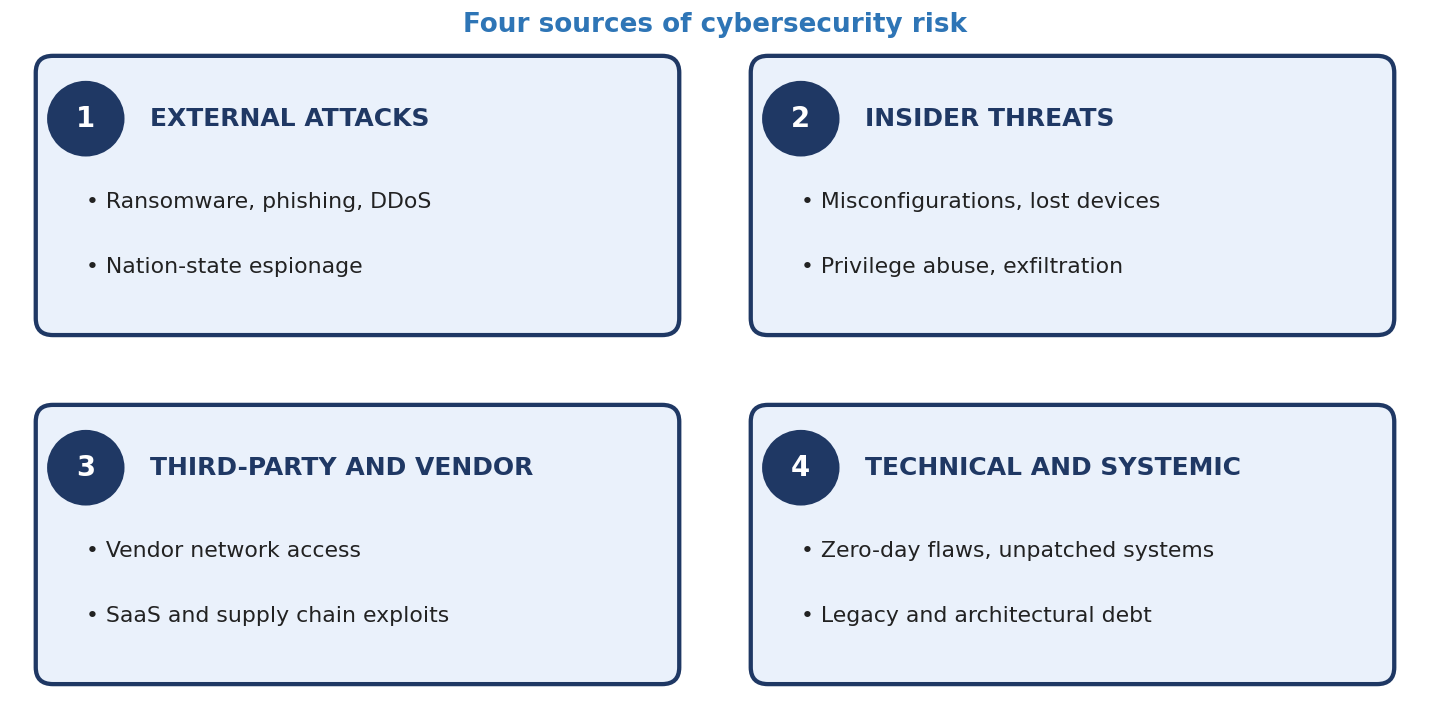
- External cyber attacks. Ransomware extortion, credential stuffing, phishing, and state-sponsored espionage. Verizon reports, ransomware appeared in 48% of breaches. FBI reported $20.9 billion in US cybercrime losses in 2025; direct ransomware losses were about $32 million and exclude downtime and recovery.
- Insider threats and human factors. Misconfigurations, privilege abuse, policy violations, and malicious exfiltration. Verizon states, employee AI use rose from 15% to 45%, making shadow AI a leading non-malicious data-leak activity; mobile social engineering succeeded 40% more often than email phishing.
- Third-party and vendor risks. Supply chain flaws, unmonitored vendor access, and SaaS dependencies. Third-party involvement rose 60% in a year; IBM identifies business-partner or supply chain compromise as its largest cost amplifier. Salesloft Drift OAuth tokens opened hundreds of Salesforce environments without a new password or MFA prompt.
- Technical and systemic vulnerabilities. Unpatched legacy software, zero-day exploits, and architectural security debt. AI is shrinking the gap between disclosure and exploitation from months to hours.
The Zero-Trust Risk Reduction Framework replaces perimeter trust with identity-first verification. Under zero trust architecture, NIST SP 800-207 checks identity, device posture, and context and limits access to the task at hand. This is blast radius reduction. Vendor-reported reductions of 66% and over 70% are upper bounds, as stated by Illumio and ColorTokens. Phishing-resistant Multi-Factor Authentication (MFA), favored by CISA, anchors the identity layer. Start with privileged and internet-facing systems.
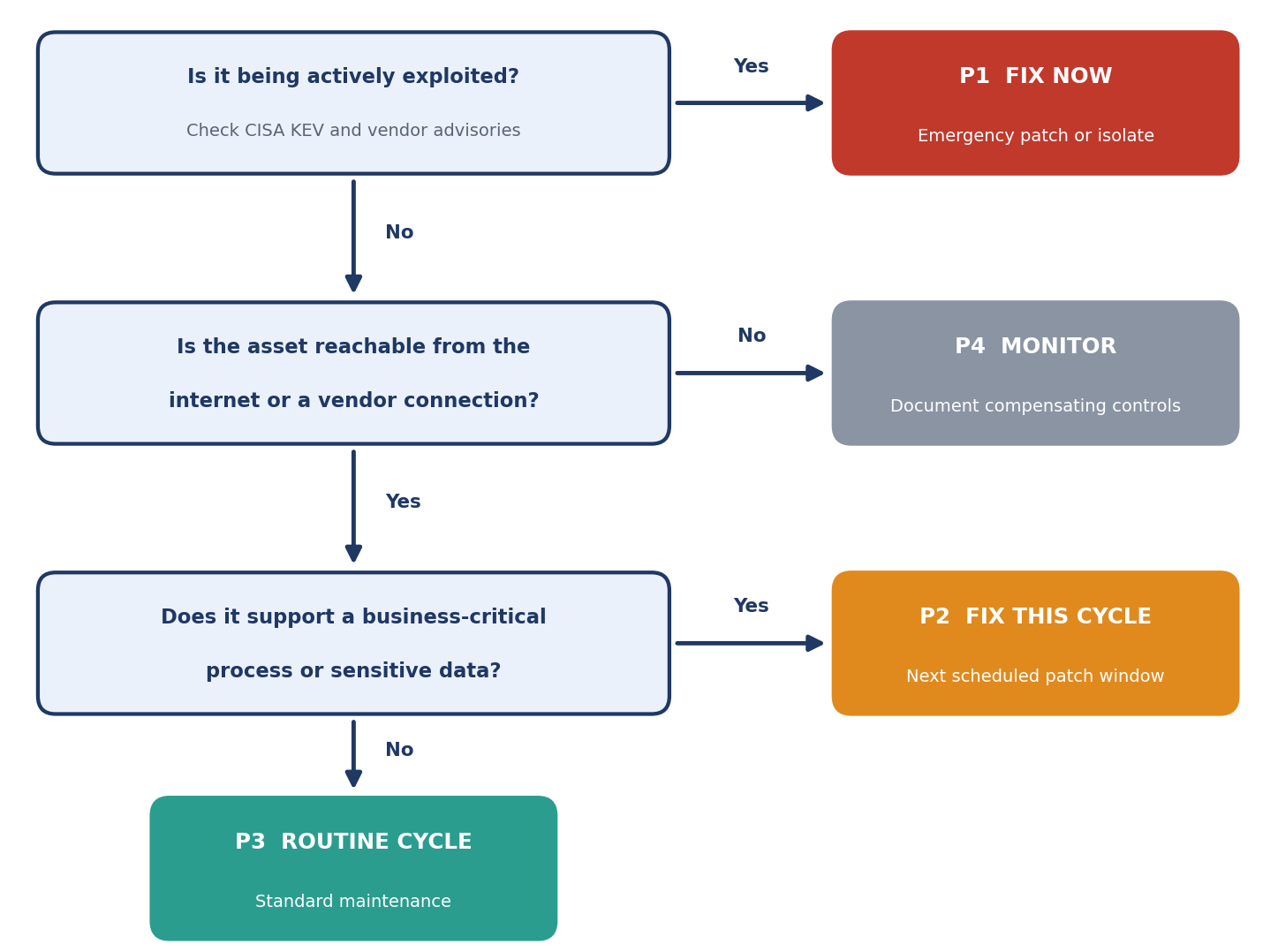
Vulnerability management keeps the fourth category proportional. Figure 3 triages findings by exploitation status, exposure, and business criticality using the CISA Known Exploited Vulnerabilities catalog. Only 26% of listed critical flaws were fully remediated in 2025; the median fix time was 43 days, as reported by Verizon.
The 5-Step Cyber Risk Management Lifecycle
The cyber risk management lifecycle is a five-step loop: discover assets, assess risk, treat it, monitor continuously, and respond under governance. Steps one and two are the cybersecurity risk assessment steps.
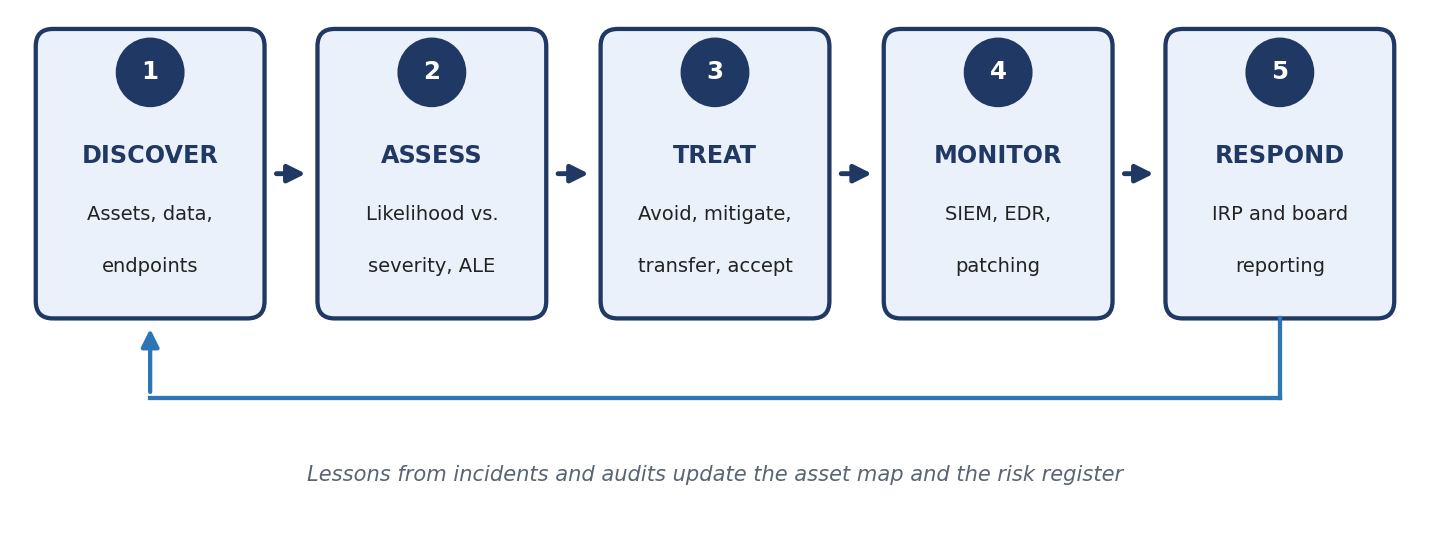
- Asset discovery and identification. Map hardware, cloud environments, data repositories, and endpoints; unknown assets are unmanaged risk.
- Risk assessment and quantification. Weigh threat likelihood against vulnerability severity and express the result in ALE so remediation follows financial exposure.
- Risk treatment and mitigation. Choose to avoid, mitigate, transfer, or accept. Cyber risk mitigation strategies include phishing-resistant MFA, EDR, Data Loss Prevention (DLP), and tested offline backups.
- Continuous monitoring and threat intelligence. Feed SIEM and EDR telemetry into security operations and patch on schedule. IBM found security AI and automation cut breach costs nearly $2 million and lifecycles 65 days.
- Incident response and governance. Execute and rehearse an incident response plan (IRP), and brief leadership after material events.
Track asset inventory completeness, time to remediate critical flaws, and time to detect an intrusion.
| Financial impact | Lower likelihood | Higher likelihood |
|---|---|---|
| High | Transfer through cyber insurance and keep core controls in place | Mitigate first, then transfer the residual |
| Low | Accept and document within risk appetite | Mitigate with low-cost automated controls |
Insurance transfers financial loss to a carrier but leaves regulatory, operational, and reputational cybersecurity risk with the business. Underwriters commonly ask for evidence of MFA, EDR, and tested backups.
Standard Cyber Risk Frameworks Compared (NIST CSF vs. ISO 27001 vs. CIS Controls)
A cyber risk management framework gives organizations a shared structure for governing, measuring, and reporting security outcomes.
| Feature | NIST CSF 2.0 | ISO/IEC 27001 | CIS Critical Security Controls |
|---|---|---|---|
| Core purpose | Outcome-based risk management across six functions | Requirements for an Information Security Management System (ISMS) | Prioritized technical safeguards |
| Certification | No | Yes, through accredited auditors, on a three-year cycle with annual surveillance audits | No |
| Style | Flexible and adaptable | Formal and audit-driven | Prescriptive and actionable |
| Best for | Board reporting at any maturity level | Customer and supplier assurance | Fast reduction of technical exposure |
The FAIR Framework adds financial quantification; selection depends on size and industry:
| Situation | Start with | Add |
|---|---|---|
| Board-level governance, mixed maturity | NIST CSF 2.0 | FAIR Framework for quantification |
| B2B or SaaS vendor facing customer audits | ISO/IEC 27001 | SOC 2 report for U.S. buyers |
| Small team without a baseline | CIS Critical Security Controls | NIST CSF 2.0 for governance |
| Healthcare provider | NIST CSF 2.0 | HIPAA Security Rule mapping |
Mature programs can combine NIST CSF for governance, ISO/IEC 27001 for assurance, CIS Controls for execution, and FAIR for dollars.
Closing the Cyber Risk Gap
Cybersecurity investment should close the gap between residual risk and the exposure the business is willing to accept. Boards should treat cybersecurity funding as a residual-to-target gap decision: set risk appetite, quantify exposure, and fund the controls that close the material gap.
- Set risk appetite before selecting tools: Define target exposure and assign an owner to each residual gap. Rationale: fund controls that reduce exposure.
- Fund the largest expected-loss reductions first: Prioritize exploited, internet-facing, business-critical vulnerabilities, phishing-resistant MFA, and material third-party exposure. Rationale: reduce likelihood or blast radius.
- Make every material control pass a payback test: Compare expected annual loss before and after the control with annual cost. Rationale: this turns a security request into a capital-allocation decision.
- Review the gap as a board metric: Recalculate after major incidents or material architecture and vendor changes. Rationale: explicit acceptance prevents unmanaged exposure.
Frequently Asked Questions
What is the difference between a cyber threat, a vulnerability, and a cyber risk?
A threat can cause harm; a vulnerability is a weakness it can exploit; cyber risk combines likelihood with business impact.
How do you calculate Annualized Loss Expectancy (ALE) for cyber risk?
Multiply SLE by ARO. A $1 million event expected once every four years has an ARO of 0.25 and an ALE of $250,000. A safeguard is economically justified when its annual ALE reduction exceeds its annual cost.
What is Third-Party Cyber Risk Management (TPRM)?
Third-party cyber risk management identifies, assesses, and monitors vendor and SaaS exposure. It covers onboarding due diligence, contractual security and incident terms, access limits with MFA, and periodic review. CISA's supply chain handbook is a practical starting point.
What are the four strategies for handling cybersecurity risk?
The four strategies are avoid, mitigate, transfer, and accept. Avoidance removes the activity; mitigation applies controls; transfer shifts financial loss; acceptance documents residual risk within appetite.